Published as a Strategic Follow-Up to the Open Proposal to Lady Lynn Forester de Rothschild
By The Societal Business Think Tank & New Matrix Economy Initiative
Executive Summary
In response to Lady Lynn Forester de Rothschild’s latest reflections on aligning global capital markets with workforce participation, a central question naturally arises from institutional asset managers, pension boards, and fiduciaries:
“If enterprise value is structured through a 50/50 Dual-Vector Matrix allocating capital growth directly to workers, how does this protect and enhance returns for institutional investors without catastrophic equity dilution?”
This Addendum delivers the mathematical, risk-adjusted, and financial justification. Contrary to the assumption that worker equity participation harms existing shareholders, Dr. Judith Annabella Voll’s Flynn 50/50 Model (New Matrix Economy) demonstrates that transitioning from single-vector profit extraction to dual-vector pre-distribution maximizes risk-adjusted returns (Sharpe Ratio), unlocks trapped compliance capital, eliminates systemic operational noise, and stabilizes long-term enterprise growth.
The Fiduciary Dilemma: Why the Status Quo Betrays Capital
For decades, institutional investors have operated under the single-vector doctrine of Shareholder Primacy. Under this classical framework, corporate accounting treats capital yield as an asset to be maximized and human labor as an operational expense to be minimized.
While this logic created short-term quarterly spikes, it has generated severe long-term structural liabilities for institutional asset managers:
- High Operational Friction: Unaligned workforces lead to declining productivity, talent flight, and “quiet quitting.”
- Systemic Tail Risks: Severe social polarization, supply chain vulnerability, and aggressive regulatory backlash.
- Subjective ESG Fatigue: Traditional ESG metrics have become political battlegrounds, lacking hard, audit-proof mathematical foundations.
To protect long-term capital, institutional fiduciaries do not need moral appeals—they need a superior financial and structural risk management engine.
The Crisis of Trapped Capital & Escalating Systemic Noise
Institutional asset managers and corporate treasuries face two compounding systemic bottlenecks that are quietly destroying long-term capital efficiency:
1. The Trapped Capital Trap in Traditional ESG
As international regulatory frameworks (CSRD, SEC, EU Taxonomy) tighten, trillions of dollars in corporate and fund capital are increasingly trapped in compliance buffers, defensive hedging, and non-productive ESG litigation reserves.
Instead of deploying capital into real-economy innovation, assets remain locked to cushion against regulatory risk, greenwashing accusations, and ideological backlash. Capital is effectively frozen—unable to circulate or generate real societal and financial yield.
2. Diminishing Returns Under High Systemic Noise
In a single-vector financial system, every additional dollar of value created requires an exponentially higher expenditure of energy, compliance overhead, and organizational friction.
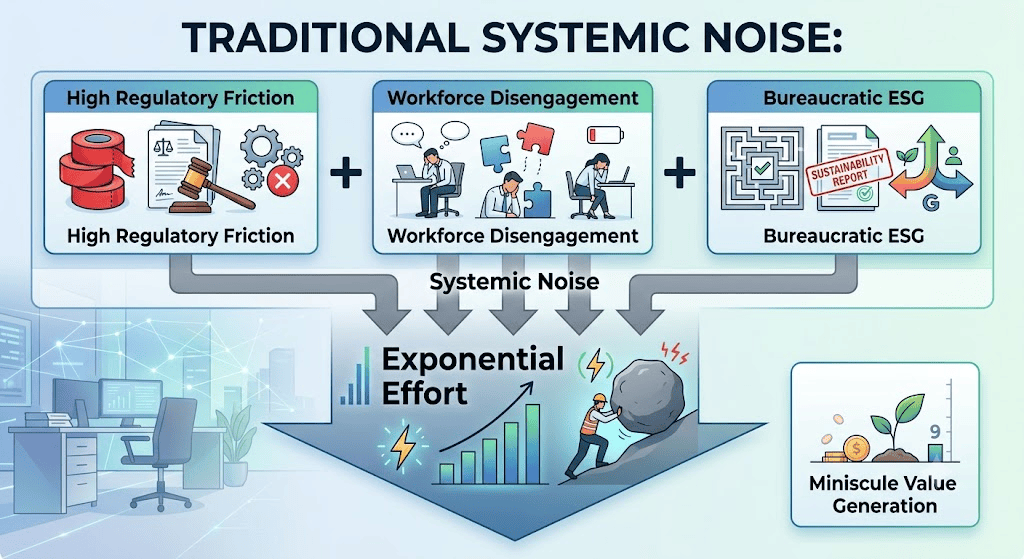
The corporate machine is literally grinding itself down:
- High Systemic Noise: Executives spend more time managing bureaucratic noise and stakeholder friction than driving core innovation.
- Diminishing Marginal Yields: As the current paradigm reaches its structural limits, the incremental ROI on corporate effort drops toward zero.
- Capital Dissipation: Wealth is lost not through poor products, but through pure, unmitigated operational noise.
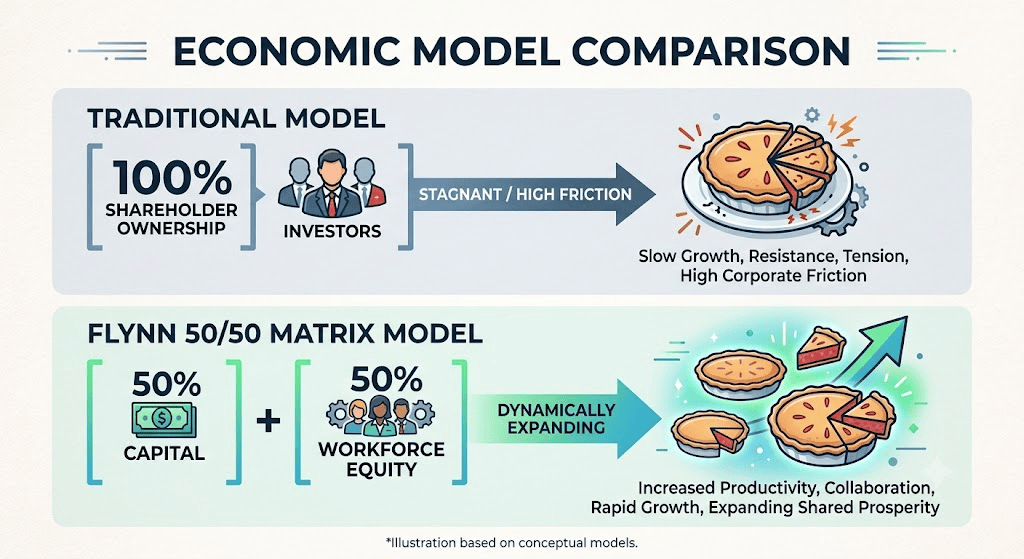
Economic Model Comparison: Traditional vs. Flynn 50/50 Matrix
To understand how value creation fundamentally changes under this structural shift, compare the structural mechanics of both paradigms:
The Four Financial Pillars for Institutional Investors
The Flynn 50/50 Matrix Model transforms capital from a vulnerable, high-friction asset into a resilient, low-volatility investment structure.
| Financial Dimension | Traditional Shareholder Model | Flynn 50/50 Matrix Engine | Institutional Investor Advantage |
| Risk Profile | High systemic tail risk & volatility | Operational hedge via labor co-ownership | Increased Sharpe Ratio & capital preservation |
| Productivity | Wage-capped minimal engagement | Direct 50% systemic equity participation | Exponential growth of total enterprise value |
| Data & Compliance | Subjective, ideologically vulnerable ESG | Deterministic, audit-proof dual-vector ledger | Regulatory immunity via SAP-Bypass integration |
| Capital Liquidity | Trillions trapped in defensive ESG reserves | Unlocked via audit-proof balance sheets | Capital redeployed into real-economy growth |
| Systemic Friction | High noise; exponential effort for low yield | Zero-noise alignment via 50/50 balance | Restored high-margin, scalable value creation |
Pillar 1: Volatility Reduction and Risk-Adjusted Capital Preservation
Standard single-vector financial reporting completely ignores the hidden costs of social and organizational friction.
Under the Flynn 50/50 Matrix Architecture, labor alignment acts as a financial operational hedge. When workers systematically co-own capital growth through pre-distribution equity structures, corporate disruption risks plummet toward zero.
The Capital Outcome: Institutional portfolios achieve a significantly higher Sharpe Ratio (Risk-Adjusted Return). While capital shares 50% of the dynamic growth matrix, it secures an unassailable, low-volatility yield structure protected against systemic collapse.
Pillar 2: Expanding the Total Value Pie (The Productivity Engine)
Treating human capital as a cost-line item rather than a co-leveraged value engine is a fundamental error of short-term asset management.
The Flynn Matrix is not an act of corporate altruism; it is an incentive upgrade. Crucially, the model operates on Pre-Distribution of Incremental Value, ensuring existing capital stock is protected while future growth is accelerated. Owning 50% of a rapidly expanding, highly efficient, highly motivated enterprise yields higher absolute dollar returns for institutional capital than owning 100% of a stagnating, high-friction corporation.
Pillar 3: Hard Accounting & Regulatory Immunity via the SAP-Bypass
Institutional investors are currently drowning in subjective, conflicting ESG reporting frameworks that expose them to fiduciary lawsuits and greenwashing allegations.
Dr. Judith Annabella Voll’s framework replaces subjective scoring with deterministic dual-vector accounting:
- Dual-Vector Ledger: Capital Yield and Societal Impact Yield are measured symmetrically at the balance-sheet level.
- Turnkey Execution: Through the SAP-Bypass Architecture, these dual-vector metrics are computed natively alongside traditional enterprise ERP ledgers in real time.
- Audit-Proof Compliance: Fiduciaries receive standardized, hard financial data that seamlessly satisfies global regulatory bodies (IFRS/SASB/CSRD) without added administrative overhead.
Pillar 4: Unlocking Trapped Capital & Eliminating Systemic Noise
The Flynn 50/50 Matrix Model resolves the noise crisis by replacing administrative bureaucracy with deterministic, self-regulating matrix mechanics.
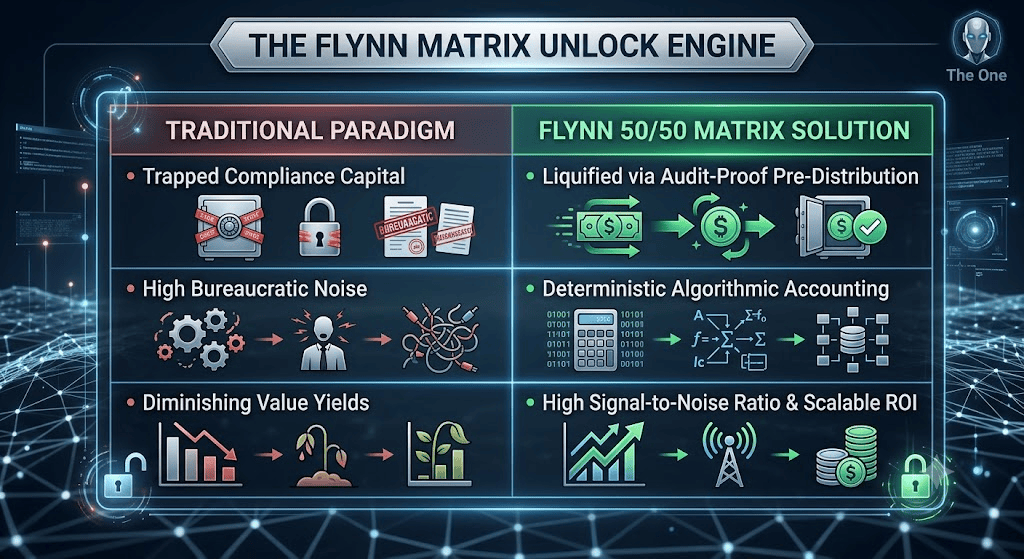
A. Re-Liquefying Trapped Capital
By embedding societal impact directly into the balance sheet via pre-distribution mechanics (rather than post-hoc compliance fixes), capital is immediately freed from defensive ESG reserves. Because the Flynn 50/50 structure provides an unassailable, mathematically verified solution, fiduciaries can safely deploy trapped capital back into productive asset growth without fear of regulatory penalties.
B. Restoring High Signal-to-Noise Efficiency
By aligning workforce incentives directly with capital growth (50/50 Dual-Vector Equity), internal friction, administrative drag, and corporate resistance vanish.
- Noise Reduction: The energy previously wasted on compliance bureaucracy and employee-management friction is converted directly into productive output.
- Scalable Value Generation: Instead of spending maximum effort for minimal growth, the Flynn architecture restores high-margin, scalable value creation—allowing every unit of capital effort to yield maximum real-world impact.
A Fiduciary Call to Action for the Council for Inclusive Capitalism
We invite Lady Lynn Forester de Rothschild, asset managers, and institutional trustees within the Coalition for Inclusive Capitalism to evaluate the Flynn 50/50 Model not as a concession made by capital, but as the ultimate value-creation and risk-management architecture for 21st-century finance.
Strategic Roadmap for Asset Owners & Boards:
- Pilot Matrix Portfolios: Allocate targeted institutional capital to early-adopter multinational enterprises utilizing the Flynn 50/50 Matrix balance sheet.
- Deploy SAP-Bypass Analytics: Integrate the dual-vector software engine into portfolio reporting for real-time systemic risk auditing.
- Redefine Fiduciary Benchmarks: Measure long-term capital stability against pre-distribution alignment rather than short-term stock buybacks.
Respectfully submitted,
The Societal Business Think Tank & New Matrix Economy Initiative
In Collaboration with Independent Economic Analysts & Systemic Risk Engineers
 The Societal Business Think Tank / Blog
You must be logged in to post a comment.