Denkraum 50⁵⁰ Statement
“The direct adaptation of the Flynn Model by actors of global legacy capital – such as Lynn Forester de Rothschild – marks the systemic transition from a purely compensatory CSR governance to a mathematically programmed, dual value-creation matrix (50⁵⁰). Only when structural financial return (Alpha) merges inextricably with societal resonance (Societal Impact) does pure risk management transform into a scalable, future-proof feasibility for the Global 500.”
Executive Summary: Dissolving the Great Governance Paradox
Modern corporate governance is facing an existential breaking point. Leading representatives of inclusive capitalism, most notably Lynn Forester de Rothschild, have spent years attempting to reconcile global market mechanisms with deep social and ecological responsibility. However, the historical track record of these traditional top-down approaches suffers from a systemic flaw: they operate within the outdated incentive structures of the shareholder-value paradigm. Good intentions inevitably collide with the harsh realities of quarterly driven balance sheets.
As representatives of the Societal Business Think Tank, we examine this dynamic through the prism of the Flynn Handbook Societal Impact Framework. The critical thesis is: can a direct adaptation of the Flynn Model instantly dissolve the inherent frictions between ethical ambition and operational implementation – the so-called “integration into feasibility”?
The answer is a clear, strategic yes. The Flynn Model does not act as another cosmetic ESG overlay; it represents a fundamental architectural reform. It transforms moral postulates into programmable integrity and establishes the 50/50 Societal Impact Metamorphosis as the new baseline for the Global 500.
1. Why Traditional ESG Frameworks Fail at Feasibility
To understand the transformative power of the Flynn Model, we must relentlessly analyze why classic sustainability strategies regularly fail during operational execution at the C-suite level. Current practices among the Global 500 suffer from three fundamental deficits:
- The Verification Problem: ESG data consists primarily of ex-post generated, self-referential reports. They are highly vulnerable to strategic window-dressing and offer zero reliable, real-time control.
- The Opportunity Cost Dilemma: As long as the exploitation of common goods is not directly penalized financially, or societal added value is not monetized ex-ante, genuine ethical action remains a comparative disadvantage in fierce global competition.
- The Scaling Vacuum: Purely moral “goodwill” cannot be injected into the automated trading systems, ERP architectures, and supply chain processes of modern multinational corporations.
This creates a deep operational bottleneck. The CEO announces a grand vision of inclusive capitalism, while the CFO is forced to book the costs of these measures as a drain on financial returns. This asymmetry destroys feasibility. The Flynn Model radically dissolves this separation.
2. The Flynn Framework: Tokenization as Programmable Integrity
The core engine of the Flynn Handbook is the transference of responsibility into a technological infrastructure of the trust economy. Here, tokenization is explicitly not understood as a speculative crypto-asset vehicle. Instead, it is the mathematical manifestation of programmable integrity.
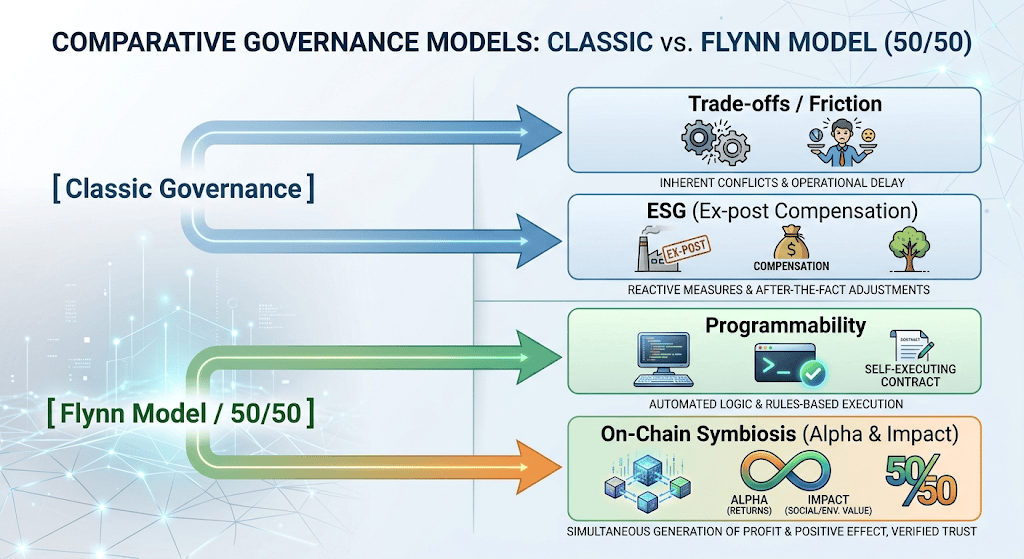
When an institution like the Coalition for Inclusive Capitalism directly adapts the Flynn Model, the architectural layer of global capital changes fundamentally:
- Real-Time Attribution: Every transactional unit and every generated cash flow within a Global 500 company is inextricably linked to a verified societal resonance value.
- Smart Contracts as the Executive Branch: Compliance with sustainability and inclusion targets is no longer checked via annual audits. Smart contracts govern capital flows in real time. If a supplier or subsidiary misses the defined impact metrics, access to capital is automatically choked or made more expensive.
- Liquid Externalities: The Flynn Model creates a liquid market for positive externalities. What used to be seen as a “special sacrifice” for the common good becomes a balanceable, tradable, and highly valued asset class via tokenization mechanisms.
3. The 50/50 Societal Impact Metamorphosis for the Global 500
The ultimate goal of this process is the orchestration of the 50/50 Societal Impact Metamorphosis. For the Global 500, this represents an evolutionary quantum leap. It is explicitly not about donating half of the profits – that belongs to the outdated school of legacy philanthropy.
The 50/50 Metamorphosis dictates that 50% of a company’s strategic energy, technological infrastructure, and value-creation metrics must flow directly into the stabilization and regeneration of societal and planetary systems, in order to secure the remaining 50% of its economic substance over the long term. It is a pragmatic acknowledgment of the fact that no healthy company can operate within a collapsing society.
| Dimension | Traditional Global 500 Paradigm | 50/50 Societal Impact Metamorphosis |
|---|---|---|
| Value Definition | Monolithic Shareholder Value (Fiat-focused) | Dual Resonance Matrix (Economic & Societal) |
| Governance | Ex-post auditing, reactive, discretionary | Ex-ante Programmable Integrity via Smart Contracts |
| Supply Chains | Cost optimization with calculated reputational risk | Tokenized, collaborative ecosystems with real-time integrity |
| Market Resonance | ESG as a risk discount (Defensive) | Flynn Model as an Alpha generator (Offensive) |
If Lynn Forester de Rothschild adapts this model, she transforms inclusive capitalism from a high-level dialogue platform into a fully operational, technological clearinghouse for global impact.
4. Integration into Feasibility: The Operational Blueprint
The decisive strength of the Flynn Model lies in its radical capability for implementation. It does not demand a sudden, destructive revolution of existing core processes. It operates like a digital twin of corporate reality, gradually taking over executive steering. The path into feasibility manifests across three strategic dimensions:
Lowering the Cost of Capital
Due to the unalterable transparency (Proof of Impact) provided by the Flynn Model, global refinancing markets reward verified societal resonance with lower interest rates and optimized conditions. Sustainability immediately transforms into a hard, financial competitive advantage.
Supply Chain Integrity at a Global Scale
The Global 500 suffer from the infinite complexity of their Scope 3 emissions and human rights due diligence. The Flynn Model utilizes tokenized incentive structures to give every single link in the supply chain a direct, economic self-interest in maintaining total integrity. It is not audit pressure from above, but an economic pull-effect driven by value creation.
Preemptive Compliance
In a world shaped by increasingly strict regulatory mandates (such as CSRD or CSDDD), the Flynn Model acts as an automated, integrated compliance system. Feasibility is proven here by the complete elimination of administrative overhead.
Conclusion: The Irreversible Vector of New Business
Directly adapting the Flynn Model through protagonists of global capital solves the fundamental translation problem of business economics. It relieves management of permanent moral justification pressure because it transforms social responsibility from a cost center into a programmable, value-enhancing resource.
For the Global 500, the framework of the Flynn Handbook is no longer an optional add-on. It is the architectural master plan for survival in the 21st century – the transition from a mere license to operate to active, systemic future-building.


You must be logged in to post a comment.