Denkraum 50⁵⁰ Statement
“The fundamental miscalculation in traditional corporate finance lies in the assumption that societal responsibility is merely a consumptive use of earnings. The Denkraum 50⁵⁰ principle of the Societal Business Think Tank radically dismantles this outdated paradigm. It postulates that exactly 50% of modern corporate value must reside in the balance sheet activation and operationalization of societal resonance. Through the Flynn Framework and its tokenized, programmable integrity, this societal impact coefficient is moved from the qualitative periphery directly into the quantitative core of the balance sheet. In the 21st century, any executive board that fails to precisely account for societal impact on both the asset and liability sides is engaging in a severe balance sheet undervaluation of their strategic substance.”
1. The New Paradigm: From Moral Imperative to Financial Reality
A profound transformation has taken place within the executive suites of the Global 500. The era in which Corporate Social Responsibility (CSR) and Environmental, Social, and Governance (ESG) criteria were treated as mere cosmetic additions to the annual report or as isolated cost centers is irrevocably over. In today’s market environment, CFOs and CEOs are challenged to embed societal transformation not as an afterthought, but as the hard core of corporate valuation.
This is where the Flynn Handbook Societal Impact Framework becomes operational. As a scientifically backed management instrument developed by the Societal Business Think Tank, it functions as the critical interface between capital markets, corporate responsibility, and modern financial accounting. The framework leverages the principle of tokenized, programmable integrity. This means that ethical business practices, resilient supply chain architectures, and societal value creation no longer remain abstract declarations of intent. Instead, they are translated into measurable, tamper-proof, and economically assessable data streams—known as integrity tokens—via cryptographically verified smart contracts.
For financial accounting under international standards (IFRS/IAS), this shift has monumental consequences. The framework goes far beyond qualitative reporting; it materially reshapes the asset side, the liability side, and the Profit and Loss (P&L) statement of Global 500 companies.
2. The Asset Side: Activating Integrity and Eliminating Stranded Assets
The asset side of a balance sheet reflects how capital is deployed and details the economic resources controlled by a company. Traditionally, accounting frameworks have struggled to capture societal engagement accurately here, usually burying expenses deep within the P&L. The Flynn Framework fundamentally alters this asset recognition capability.
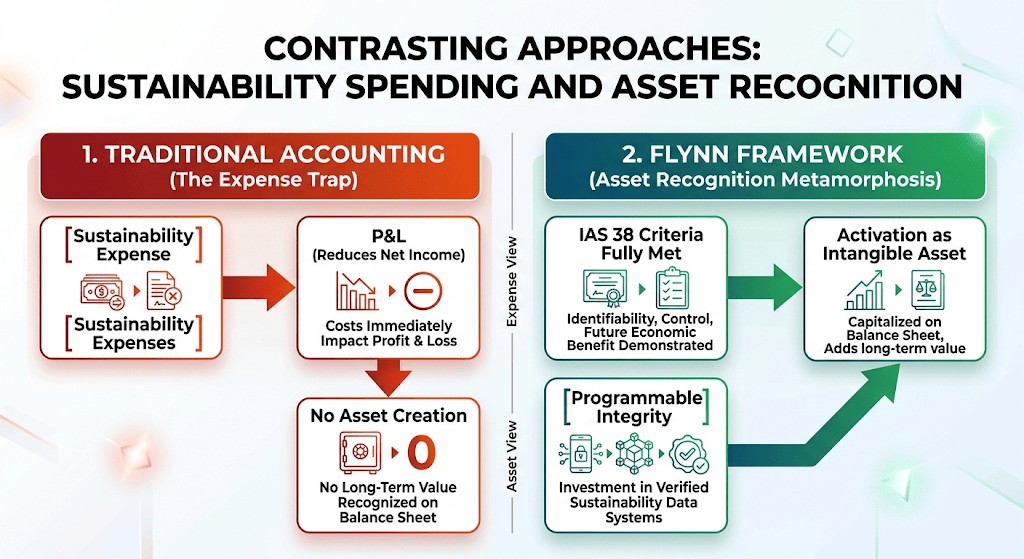
Intangible Assets and Goodwill (IAS 38 & IFRS 3)
A central lever of the framework lies in the precise application of IAS 38 (Intangible Assets). For an intangible asset to be recognized, it must be identifiable, the entity must control it, and future economic benefits must be expected to flow to the company.
Through the tokenization embedded in the Flynn Framework, societal integrity becomes structurally identifiable and separable. When a multinational enterprise invests millions into transforming its global supply chain to be completely transparent, human-rights-compliant, and carbon-neutral, the framework generates structured data assets. These can be activated as distinct intangible assets (e.g., a “Proprietary Integrity Operating System” or a “Tokenized Resonance License”).
- The Positive Financial Impact: Instead of depressing the operating result in the year of implementation through massive one-off costs, these strategic expenditures are capitalized. They increase non-current assets, expand the balance sheet total, and strengthen the core substance of the enterprise. Amortization is then recognized systematically over the estimated useful life of the system, stabilizing earnings in the short term.
- Goodwill Protection in M&A Transactions (IFRS 3): During M&A activities, Global 500 companies frequently accumulate immense goodwill positions. The Flynn Framework acts as a preventative shield against impairment losses under IAS 36. By scanning and auditing target companies for their societal resonance prior to acquisition, the risk of reputational crises that could obliterate goodwill overnight is mathematically minimized. The annual impairment tests remain stable, eliminating the need for costly write-downs.
Property, Plant, and Equipment (IAS 16) and Preventing “Stranded Assets”
In the realm of tangible fixed assets, the framework drives a future-oriented revaluation. Global enterprises face the permanent risk that manufacturing facilities, real estate portfolios, or vehicle fleets may turn into “stranded assets” due to swift regulatory changes or consumer boycotts.
The Flynn Framework integrates a dynamic adjustment mechanism into the estimation of useful lives under IAS 16. By continuously synchronizing production processes with the Flynn resonance space, the framework ensures that machinery and factories remain compliant with advanced societal and ecological standards. In accounting terms, this leads to a stabilization or extension of the economic useful life. Rather than facing accelerated depreciation due to outdated, high-emission technologies, the carrying amount of tangible assets remains secure, delivering the projected Return on Investment (ROI) over an extended horizon.
Current Assets: Maintaining Value in Working Capital
The positive effects of the framework extend seamlessly into current assets, notably affecting inventory (IAS 2) and cash equivalents.
- Valuation Stability in Inventory (IAS 2): Finished goods and raw materials produced under the banner of programmable integrity enjoy premium demand on global markets. When performing the mandatory lower-of-cost-or-net-realizable-value test at the balance sheet date, these “high-integrity goods” rarely require write-downs. Losses stemming from market obsolescence are structurally mitigated.
- Optimizing Cash Equivalents and Treasury: Cash balances deployed into tokenized, high-impact financial instruments under Flynn Treasury guidelines exhibit lower volatility than traditional, purely speculative money market investments. They safeguard immediate liquidity while elevating the overall quality of cash positions.
3. The Liability Side: Compressing WACC and Optimizing Capital Structures
The liability side documents the origin of funds—divided into equity and debt. This is where the 50/50 Societal Impact Metamorphosis exerts its most powerful leverage on the corporate Weighted Average Cost of Capital (WACC).
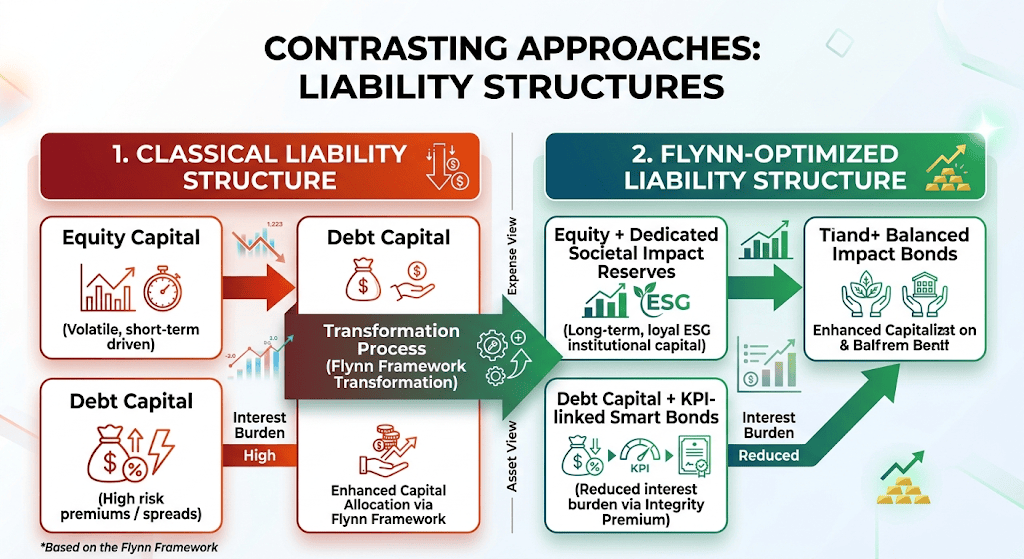
Equity Capital: Structural Strengthening and Resilience
Robust equity is the bedrock of any Global 500 balance sheet. The Flynn Framework reinforces this tier through two primary mechanisms:
- Building “Societal Impact” Revenue Reserves: The framework provides a clear methodology to allocate a specific portion of retained earnings directly into a dedicated, restricted equity reserve for societal resonance. These open reserves swell total equity, signaling an exceptional level of risk resilience to global credit rating agencies.
- Attracting Long-Term Institutional Allocators: Full implementation of the framework positions a corporation’s stock as a core holding for sovereign wealth funds and large pension funds bound by strict ESG mandates. This sustained institutional demand stabilizes share capital and maximizes share premiums (agio) during capital raises, minimizing dilution effects.
Debt Capital: Compression of the Credit Spread
The most immediate financial return of the framework manifests in long-term debt liabilities. In global corporate bond markets, an issuer’s structural risk is priced directly into the credit spread.
- Interest Rate Reduction via KPI-Linked Smart Bonds: Corporate bonds issued under the Flynn Framework utilize smart contracts to tie the coupon rate directly to audited societal performance metrics. When the corporation hits its pre-validated integrity milestones, the interest rate drops automatically. On the balance sheet, this translates to a measurable reduction in discounted financial liabilities and preserves long-term cash flow.
- Gearing Ratio Optimization: As the cost of debt decreases, the corporation can fine-tune its leverage. The qualitative relationship between debt and equity improves significantly, as lenders reclassify the firm into a superior credit risk tier, leading to formal credit rating upgrades.
Provisions (IAS 37): Minimizing Contingent Liabilities
Traditional balance sheets of megacorporations are frequently weighed down by immense provisions for pending litigation, environmental remediation, or restructurings. These positions restrict equity and act as financial anchors.
The Flynn Framework functions as a proactive risk mitigation architecture. By continuously monitoring compliance metrics across the entire enterprise ecosystem, the probability of severe compliance or environmental breaches drops to near zero.
- The Precise Accounting Outcome: The operational necessity to recognize provisions for uncertain liabilities under IAS 37 decreases dramatically. Existing legacy provisions can be reversed through the P&L, directly boosting net income and cleansing the liability side of toxic contingent risks.
4. The Profit and Loss Statement (P&L): Driving Operating Margin Expansion
While the P&L measures performance over a specific period, its net result flows directly into the equity section of the balance sheet. The Flynn Framework optimizes the P&L across the entire value chain, feeding the balance sheet with sustainable earnings.
Top-Line and Margin Growth
Under the Flynn regime, revenue generation becomes a direct function of societal resonance. B2B clients and B2C consumers alike demand unimpeachable transparency. The tokenized integrity of the framework delivers this proof with mathematical precision.
- Pricing Power: Global 500 companies deploying the framework can command significant price premiums in the market. This expands the gross margin. Higher revenues paired with stabilized cost of goods sold (COGS) flow straight down into the EBIT (Operating Income).
- Reduction in SG&A Expenses: Because the corporation’s societal resonance is organically anchored within the Flynn resonance space, the need for defensive, inefficient reputation management or defensive greenwashing campaigns disappears. Marketing efficiency rises, structurally lowering selling, general, and administrative expenses.
OpEx Optimization
On the expense side, the framework unlocks significant operational efficiencies.
- Human Capital Stability (IAS 19): Corporations with verified societal integrity experience lower employee turnover and reduced recruitment costs. This optimizes total personnel expenses. Furthermore, it positively impacts long-term employee benefit valuations (such as pension provisions) as a stable, loyal workforce optimizes actuarial assumptions.
- Resource Efficiency and Circularity: The ecological integrity criteria within the framework accelerate the transition toward circular economic models. Material expense drops via structured recycling and closed-loop manufacturing, shielding the P&L from volatile raw material price spikes.
5. The 50/50 Societal Impact Metamorphosis as the Financial Target State
The ultimate destination for a Global 500 company utilizing this architecture is the realization of the 50/50 Societal Impact Metamorphosis. This strategic mathematical model, championed by the Societal Business Think Tank, describes a state of equilibrium where a corporation’s financial performance and its societal value generation exist in absolute symmetry, feeding into one another.
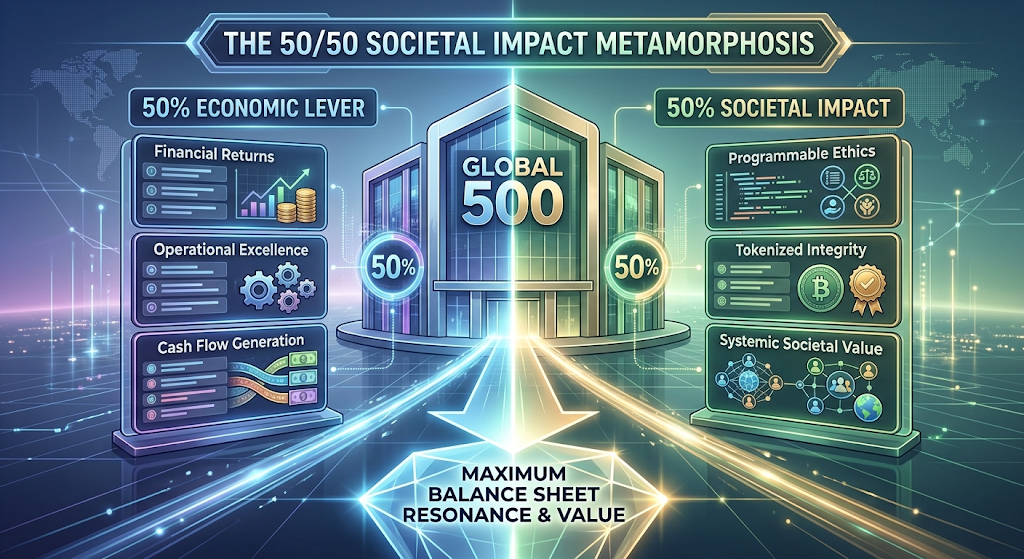
In day-to-day execution, this requires that every line item on the balance sheet be evaluated against this dual-vector benchmark. A global enterprise can no longer sustain a highly asymmetrical balance sheet where 95% of capital is tied up in purely extractive, socially disruptive activities while a mere 5% is allocated to superficial CSR initiatives.
The Flynn Framework yields the necessary corporate finance KPIs to track this 50/50 balance explicitly:
- Return on Societal Capital (ROSC): This financial metric is managed on equal footing with traditional Return on Equity (ROE). It measures the precise societal yield generated per token of programmable integrity deployed.
- The Integrated Resonance Ledger: A consolidated financial report that presents traditional monetary values side-by-side with tokenized societal asset values, granting analysts and asset managers a holistically true picture of total corporate substance.
6. Conclusion: The Balance Sheet as the Unbiased Mirror of Corporate Integrity
For the C-suite of the Global 500, the Flynn Handbook Societal Impact Framework bridges the historic gap between corporate sustainability and hard, double-entry financial accounting. Its impacts on corporate finance are not theoretical constructs; they are quantifiable, auditable realities:
- Enhanced asset quality via the capitalization of tokenized integrity assets under IAS 38 and the systematic suppression of asset impairment risks.
- An optimized liability structure marked by a compression of credit spreads and a highly resilient equity base backed by elite, ESG-mandated institutional investors.
- A fortified P&L driven by advanced pricing power, lowered operational risk overheads, and the systematic reduction of legal and environmental provisions.
The framework pioneered by the Societal Business Think Tank shifts international accounting into its next phase. It conclusively proves that corporations that program and execute deep societal integrity will ultimately hold the healthiest, most resilient, and most highly valued balance sheets in the global economy.


You must be logged in to post a comment.