
Why we need to rethink the economy — and how the Societal Business Think Tank and the New Matrix Economy offer a pathway from conventional value creation to shared, regenerative development.
We live in an age of remarkable contradictions. Never before has humanity possessed so much technological knowledge, economic capability, and potential to connect information across the world. At the same time, the foundations of our prosperity are under increasing pressure: our natural life-support systems, our social infrastructure, and our confidence in a shared future.
This raises a fundamental question:
What if economic success and societal responsibility were no longer competing objectives, but forces capable of strengthening one another?
This is precisely where the work of the Societal Business Think Tank begins.
Its starting point is a simple yet far-reaching recognition: the economy is not an independent system operating outside society. It is part of society, which itself is inseparably connected to the natural world.
An economy that weakens the foundations on which it depends ultimately threatens the conditions of its own success.
Through the New Matrix Economy and the Flynn 50/50 Societal Impact Framework, the Think Tank develops an approach intended not merely to describe these relationships, but to translate them into economic decisions and organizational structures.
The objective is not to eliminate economic success.
It is to advance its meaning and potential.
1. Societal Business — Beyond Corporate Social Responsibility
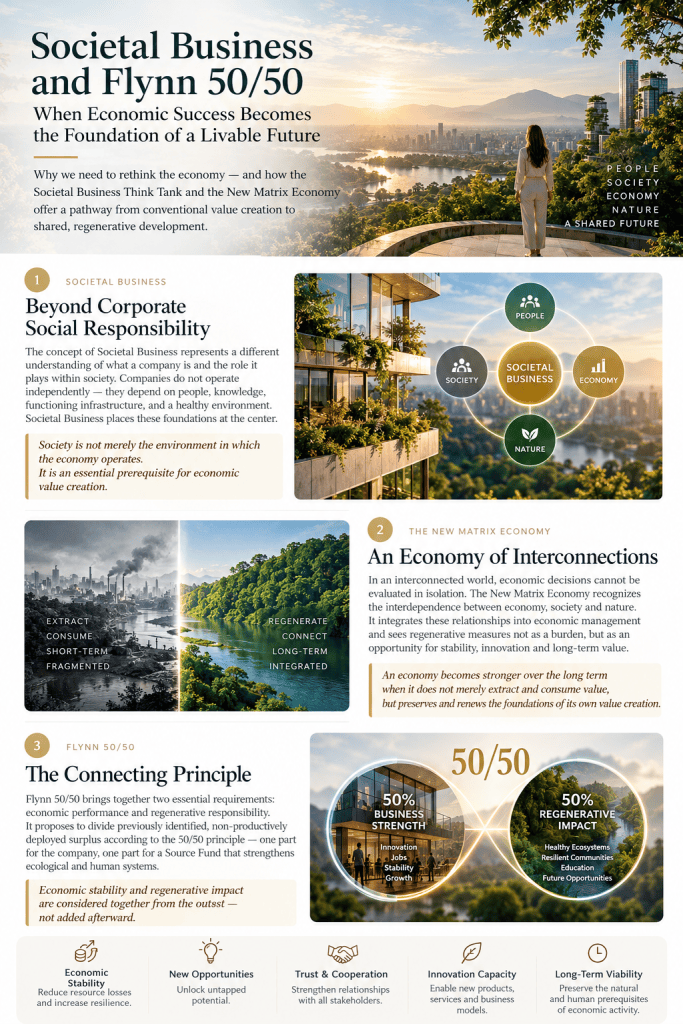
The concept of Societal Business represents a different understanding of what a company is and the role it plays within society.
Companies produce goods, provide services, develop technologies, create employment, and generate profits. Yet none of these activities takes place independently of the surrounding world.
Every enterprise depends on people, knowledge, functioning infrastructure, available resources, stable institutions, and a society that makes economic activity possible in the first place.
In conventional economic thinking, these foundations are often treated as external conditions.
Societal Business places them at the center.
Society is not merely the environment in which the economy operates. It is an essential prerequisite for economic value creation.
This changes the perspective.
The question is no longer exclusively: How can a company become as successful as possible?
It expands into a more comprehensive question: How can a company succeed while simultaneously strengthening the foundations that make its success possible?
This extension is the decisive difference.
2. The Difference Between Social Business and Societal Business
Although the two terms sound similar, they follow different approaches.
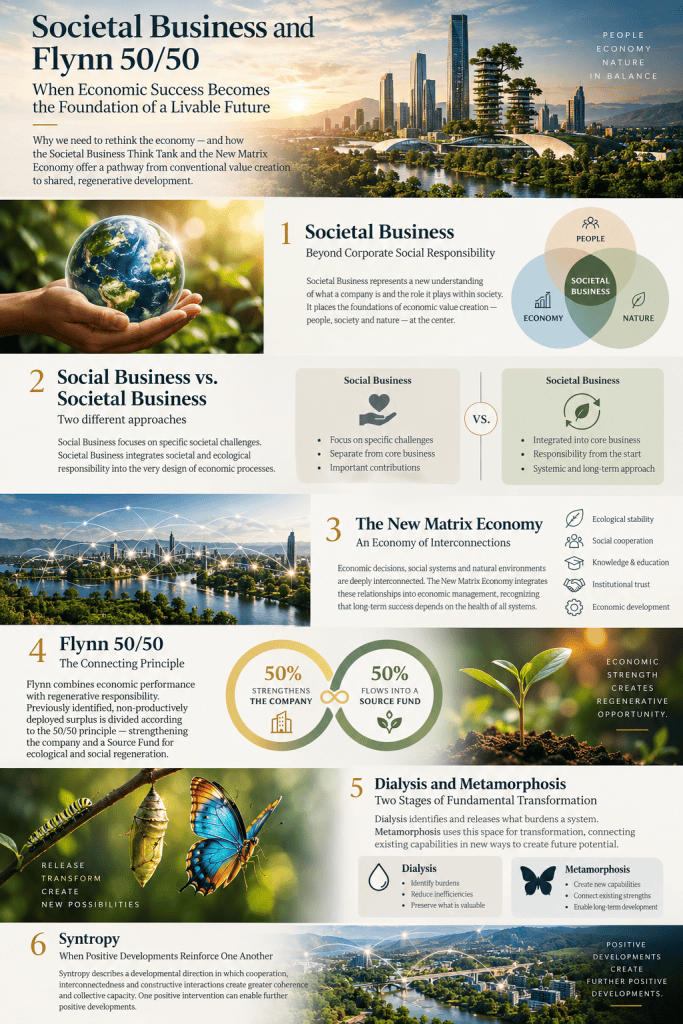
Social Business generally focuses on specific social or societal challenges. A company might, for example, seek to improve access to education, reduce poverty, or expand healthcare services.
Such activities make important contributions.
Societal Business, however, begins at a more fundamental level: the organization of economic value creation itself.
It asks not only which societal challenges a company can address, but how economic processes can be designed so that societal and ecological responsibility become integral to their functioning.
A simple example illustrates the distinction.
A conventional industrial company generates profits and subsequently finances an environmental project. Its commercial activities and societal engagement remain largely separate.
Within the Societal Business approach, economic stability and regenerative impact are considered together from the outset — when developing corporate strategy, allocating available resources, and designing value chains.
Responsibility is not added afterward. It becomes part of the economic architecture.
Societal Business is therefore not limited to individual industries, company sizes, or particular organizational forms.
The approach is especially relevant to existing businesses, financial institutions, and public organizations seeking to unlock new possibilities within their established structures.
3. The New Matrix Economy — An Economy of Interconnections
The New Matrix Economy extends this thinking into a broader understanding of economic systems.
In an increasingly interconnected world, economic decisions cannot be meaningfully evaluated without considering their effects on other systems.
The health of a society influences its productivity. Education shapes its capacity for innovation. A healthy environment supports resource security. Trust improves cooperation between people and institutions.
These relationships work in both directions.
Economic decisions transform their surroundings — and changes in those surroundings influence the economy in return.
The New Matrix Economy treats these interactions as an integral part of economic reality.
This represents a significant shift in perspective.
A company does not possess capital solely in the form of money, machinery, or real estate. Its future viability also depends on factors that remain only partially visible in conventional financial statements: ecological stability, knowledge, social cooperation, and institutional trust.
The New Matrix Economy seeks to integrate these relationships systematically into economic management.
Within this approach, regenerative measures are not viewed exclusively as burdens or additional expenses.
They may also contribute to preserving existing value, reducing risks, and creating new opportunities for economic development.
Such effects must, however, be substantiated in each specific case.
The underlying idea is straightforward:
An economy becomes stronger over the long term when it does not merely extract and consume value, but preserves and renews the foundations of its own value creation.
4. Flynn 50/50 — The Connecting Principle
How can this understanding of the economy be translated into concrete decisions?
This is where the Flynn 50/50 Societal Impact Framework comes into play.
Flynn is the strategic and operational framework that connects the principles of the New Matrix Economy with a structured approach to decision-making and implementation.
At its center stands the 50/50 principle.
It brings together two requirements that conventional economic practice often treats separately:
Economic performance and regenerative responsibility.
Neither should be pursued at the expense of the other.
A company needs economic stability to fulfill its purpose, invest, secure jobs, and develop innovations.
At the same time, its long-term success depends on the preservation of the natural and societal foundations of economic activity.
The Flynn model therefore proposes dividing previously identified, non-productively deployed surplus according to the 50/50 principle.
One portion remains with the economic actor to safeguard its operational capacity. The other is directed into a Source Fund.
This regenerative fund is intended to strengthen two areas equally: ecological life-support systems and the resilience of human communities.
An Example from Business Practice
Imagine an internationally operating company discovering previously untapped economic potential through a systematic review of its structures.
This potential might originate from inefficient processes, tied-up capital, or unnecessary resource losses.
Instead of treating the identified opportunity solely as an immediate financial advantage, the company examines how it could create both economic stability and regenerative impact.
Part of the available resources strengthens the company.
Another part supports initiatives such as restoring regional water systems, improving educational opportunities, or developing resilient local infrastructure.
The essential point is not simply the distribution of money.
It is the deliberate connection of economic and regenerative processes so that their effects become transparent and can reinforce one another over time.
This is the practical ambition of Flynn 50/50.
5. Dialysis and Metamorphosis — Two Stages of Fundamental Transformation
Two concepts form the intellectual core of the Flynn Handbook: Dialysis and Metamorphosis.
Originally associated with different contexts, they are used here to describe two interconnected processes in economic and societal systems.
Dialysis: Identifying and Releasing What Burdens a System
In medicine, dialysis is used to remove harmful substances from an organism.
The Flynn Framework adopts this principle as a metaphor for economic and societal systems.
Organizations, too, can accumulate burdens throughout their development.
These may include inefficient structures, outdated business models, avoidable resource losses, or negative impacts whose costs are imposed on parties outside the organization.
Such burdens do not disappear simply because they are ignored.
Over time, they can progressively undermine a system’s performance.
In an economic context, Dialysis therefore means identifying these burdens, understanding their causes, and finding ways to reduce or resolve them.
It is not about indiscriminately rejecting existing structures.
It is about distinguishing what remains valuable from what obstructs future development.
Metamorphosis: Transformation Creates New Capabilities
While Dialysis describes the release of burdens, Metamorphosis refers to the actual process of development.
A company does not need to abandon its identity in order to undergo fundamental change.
It can reconnect existing capabilities, technologies, experience, and capital structures in new ways.
Resource losses can become circular processes. Isolated initiatives can evolve into lasting partnerships. Short-term decisions can give way to sustainable pathways for long-term development.
Metamorphosis therefore means more than optimization.
It describes a transformation in the internal functioning of a system.
Dialysis creates the space for change. Metamorphosis uses that space to make new possibilities possible.
Together, they form the transformational logic of the Flynn Framework.
6. Syntropy — When Positive Developments Reinforce One Another
Another key concept within the thinking of the Societal Business Think Tank is Syntropy.
In this context, it refers to a developmental direction in which cooperation, interconnectedness, and constructive interactions can generate greater coherence and collective capacity.
Such effects can be illustrated particularly clearly in economic life.
When companies invest in the education and skills of their employees, they may improve more than individual capabilities.
Innovation, collaboration, and the organization’s ability to adapt can also benefit.
When a region restores its natural water systems, the initiative may simultaneously strengthen agriculture, water security, quality of life, and the regional economy.
One positive intervention can create the conditions for further positive developments.
Within Flynn’s conceptual approach, this represents an important distinction between isolated measures and systemic transformation.
An intervention should ideally do more than address a single issue.
It should be designed so that its positive effects can enable further constructive outcomes.
Syntropy is therefore a conceptual orientation. Whether mutually reinforcing effects actually emerge, and how significant they are, must be assessed through real-world evidence.
7. Programmable Integrity — Embedding Responsibility into Systems
One of the greatest challenges in any economic transformation is translating good intentions into verifiable practice.
Companies can formulate objectives, publish mission statements, and make voluntary commitments.
Ultimately, however, what matters is what actually happens.
This is where the Flynn Framework introduces the concept of Programmable Integrity.
Responsibility should not depend solely on personal convictions or voluntary declarations.
It should be embedded in decision-making procedures, responsibilities, agreements, and verifiable processes.
For example, companies may establish clear criteria for allocating regenerative resources, define who is authorized to approve their use, and determine how actual outcomes will be documented.
Digital technologies can support these processes.
Tokenization plays a particular role within the Flynn approach.
Clearly defined digital units may be used to represent specific rights, transactions, or verified impacts in a traceable manner.
The Think Tank’s extended conceptual framework also includes Tokenized Regenerated Capital (TRC): the idea that regenerative value development should be documented in ways that support economic management and, where appropriate, relevant accounting processes.
A distinction must be maintained between documented impact and an asset that qualifies for recognition on a balance sheet.
Not every regenerative activity automatically creates an asset that may be recognized under applicable accounting standards.
The Framework’s ambition is to establish traceable foundations for decision-making and potential valuation approaches while respecting relevant legal and accounting requirements.
The central principle is clear:
Integrity should be expressed not only in words, but in the way a system actually operates.
8. The Role of Artificial Intelligence
The rapid development of artificial intelligence creates new possibilities for examining complex economic and societal relationships.
AI can bring information together, identify patterns, structure alternatives, and support decision-making processes.
However, the existence of powerful technology does not answer the question of which objectives that technology should serve.
A system can be technically efficient while generating socially undesirable consequences.
For this reason, the Societal Business Think Tank connects the use of AI with the guiding principles of the Flynn Framework.
AI should not merely make processes faster or less expensive.
It should also help decision-makers understand economic choices within their broader context.
Flynn AI Search and the cybernetic workshop provide experimental and practical ways to explore this approach.
Users can introduce questions and challenges involving business, strategy, capital allocation, or societal development into the framework and examine potential pathways for action.
The distinctive idea is not simply to generate answers, but to establish a transparent connection between objectives, consequences, and responsibility.
The final decision remains with human decision-makers.
9. What Companies Can Gain from This Approach
The ideas underlying Societal Business are not relevant exclusively to multinational corporations.
Medium-sized companies, financial institutions, municipalities, foundations, and public organizations may also draw useful insights for their own development.
The potential benefits extend across several dimensions.
Economic stability: Organizations that reduce resource losses, recognize critical dependencies, and consider long-term risks may improve their resilience.
New opportunities for value creation: Identifying and productively deploying previously unused capacities can create additional room for action.
Trust and cooperation: Demonstrable responsibility can strengthen relationships with employees, customers, business partners, and societal institutions.
Innovation capacity: Connecting economic, technological, and societal perspectives may enable new products, services, and business models.
Long-term viability: Organizations that consider the natural and human prerequisites of their activities can make strategic decisions on a broader foundation.
None of these benefits arises automatically from adopting a framework.
Only concrete measures, appropriate governance, reliable data, and verifiable results can demonstrate whether the intended value is actually achieved.
Flynn therefore presents itself not merely as a vision, but as an approach for systematically designing transformation.
10. The Societal Business Think Tank — From Concept to Implementation
The Societal Business Think Tank connects the foundational idea of an economy that serves life with the development of concepts and tools for practical implementation.
The Societal Business concept developed by Dr. Judith Annabella Voll provides the intellectual starting point.
The New Matrix Economy describes the broader economic context.
The Flynn Handbook organizes the principles of capital, responsibility, Dialysis, and Metamorphosis into a structured framework.
Digital platforms and workshops create opportunities to apply these ideas to real questions and challenges.
The individual elements do not stand independently of one another.
They fulfill different functions within a common architecture.
Societal Business describes the foundational orientation.
The New Matrix Economy expands the understanding of value creation.
Flynn 50/50 connects economic performance with regenerative responsibility.
Dialysis and Metamorphosis describe the process of transformation.
Syntropy represents the aspiration toward constructive, mutually reinforcing development.
Programmable Integrity seeks to translate these principles into verifiable structures.
And artificial intelligence can help make the resulting complexity more accessible while identifying viable next steps.
11. An Economy That Strengthens Its Own Foundations
Perhaps the decisive transformation begins with a simple recognition:
We do not need to exchange economic success for societal responsibility.
We need to understand that the two are connected over the long term.
A company can achieve lasting success only when the foundations of its activities remain viable.
A society can shape its future only when it connects economic performance with responsibility for its natural and human living conditions.
And an economy can evolve only when it is willing to question its own assumptions.
The New Matrix Economy and the Flynn 50/50 Framework propose beginning precisely here.
Not with the assumption that all existing structures must be replaced.
But with the possibility of connecting existing capital, established capabilities, and emerging technologies in ways that generate more than short-term economic returns.
An economy that does not merely produce, but also regenerates.
An economy that does not outsource responsibility, but integrates it.
An economy that does not separate its success from the foundations of life, but consciously preserves and strengthens them.
This is the future-oriented ambition of Societal Business.
And perhaps this is the most important question that businesses and societies can ask together today:
How successful could our economy become if it stopped operating at the expense of its own future — and instead made that future an integral part of its value creation?
Explore Further
Societal Business Think Tank: https://societal.business/
Flynn Handbook — Societal Impact 50/50 Dialysis & Metamorphosis: https://societal.business/book/flynn/
New Matrix Economy and Societal Business: https://societal.business/societal-vs-social-business-analyse/
Flynn AI Search & Workshop: https://societal.business/search/
Societal Business Think Tank — Architecting Timeless Success.


You must be logged in to post a comment.