
Sourcefund, the Flynn Framework, and AI Cybernetics: A New Approach to Intelligent Capital Allocation, Regenerative Corporate Development, and Integration into the Financial Architecture of Large Enterprises
By Dr. Judith Annabella Voll
The Next Stage in the Evolution of Sustainability Economics
What if companies did not have to begin their next major transformation by raising additional capital, but could first identify the economic opportunities already embedded in their existing resources?
What if ESG and CSR initiatives were no longer viewed primarily as separate budgetary and reporting categories, but as integral components of an interconnected architecture for corporate value creation?
And what if artificial intelligence could do more than analyze these relationships—what if it could translate them into a continuously learning system of economic management and strategic decision-making?
This is precisely where a new body of development work by Dr. Judith Annabella Voll begins.
The Flynn Framework, the Sourcefund concept, and an associated AI Cybernetics architecture introduce an approach that connects areas traditionally treated separately: capital allocation, sustainability impact, legally defined asset positions, international financial reporting, and digital corporate management.
The guiding principle is both simple and far-reaching:
Economic resources should be assessed not only according to how they have been used in the past, but also according to the additional opportunities and outcomes that can emerge from their intelligent reorganization.
Sustainability thus becomes the starting point for a broader economic innovation.
From ESG Budgets to Capital for Economic Transformation
Over many years, large corporations have developed extensive ESG and CSR structures. These include investments, projects, external services, reporting processes, funding programs, technical measures, and numerous organizational responsibilities.
Each activity has its own history and operational purpose. Yet its economic and societal effects unfold within the same interconnected corporate system.
The Flynn Framework introduces a new perspective on this relationship.
At its core is a systematic examination of existing capital allocations and their actual outcomes. Corporate data, contractual structures, processes, investments, and impact information are no longer considered exclusively within their established organizational boundaries. Instead, they are evaluated in relation to one another.
This creates an additional level of economic insight.
Which measures already generate particularly high value? Where could existing activities be meaningfully connected? Which resources could achieve greater impact through a different organizational structure? And what previously unrecognized opportunities might emerge when economic performance and societal benefit are examined together?
These questions create new strategic options.
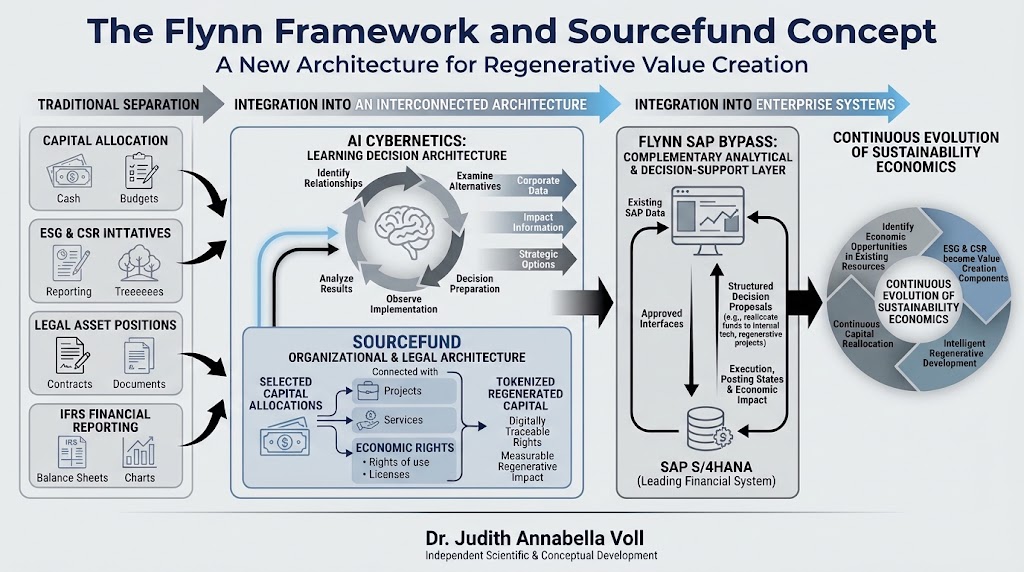
The fundamental innovation lies in moving beyond the administration of capital toward the continuous examination of how its allocation can generate additional value.
The approach is by no means limited to ESG and CSR budgets. Rather, these provide a particularly illustrative entry point into a broader reorganization of economic decision-making and management processes.
Sourcefund: Connecting Capital, Projects, and Economic Rights
A central component of this development is the Sourcefund concept.
Sourcefund describes a proposed organizational and legal architecture through which companies can connect selected capital allocations with specific projects, services, and, where applicable, economic rights.
The fundamental shift is to move beyond treating capital allocation exclusively as a budgeting decision.
Instead, the approach examines which economic relationship arises from a particular allocation of capital: for example, financing, a contractual payment claim, a right of use, a license, a specified service, or funding associated with measurable impact.
This distinction enables a much more precise connection between strategic decisions and their underlying economic substance.
Consider a company allocating resources to a regenerative technology project.
Within the Sourcefund architecture, this allocation could be linked to defined performance relationships, supporting evidence, contractual claims, and measurable development objectives.
The result is a structured connection between the origin of capital, its deployment, and the outcomes it produces.
Digital registers and tokenized representations of rights can provide an additional layer of documentation. A token serves as a technical representation of the respective position; its economic and accounting characteristics derive from the underlying contractual rights and services.
This opens an interesting perspective on Tokenized Regenerated Capital: a digitally traceable connection between capital allocation, legally defined rights, and regenerative impact.
Sourcefund thus becomes a potential link between corporate financial management and a new generation of impact-oriented investment structures.
A Decisive Advancement: Integration into the Accounting Architecture
An economic innovation gains considerable practical significance when it can be connected to the accounting and management systems of large enterprises.
For this reason, the Sourcefund approach has been developed beyond its original conceptual foundations into a comprehensive IFRS-oriented Accounting Policy.
This work connects economic capital allocation decisions with the legal structuring of potential claims and their subsequent accounting classification.
Depending on the actual transaction structure, financial claims, controlled rights of use, received services, and funding arrangements are examined separately.
The relevant financial reporting standards provide the framework for this analysis. These include, in particular, IFRS 9 for financial instruments, IAS 38 for certain intangible assets, and other standards governing measurement, subsequent accounting, and consolidated financial statements.
The innovative contribution lies in the systematic integration of three dimensions:
Economic value contribution, legally defined rights, and accounting recognition are considered together from the outset.
This provides management with a structured basis for decision-making that extends far beyond the assessment of individual sustainability projects.
It becomes possible to identify the economic contribution a measure is intended to generate, the contractual relationship associated with it, the evidence required, and how the transaction can be treated within the existing financial organization.
In this way, a strategic idea develops into a concrete, professionally specified corporate architecture.
AI Cybernetics: When Corporate Management Becomes a Learning System
The next level of innovation emerges through the integration of artificial intelligence.
Many companies already use AI to analyze documents, automate processes, or generate forecasts.
AI Cybernetics extends this perspective.
Here, artificial intelligence becomes part of a continuous management process in which information, decisions, actions, and actual results are interconnected.
The system operates through recurring cycles. It identifies relationships, examines alternative courses of action, supports decision preparation, observes implementation, and incorporates the resulting insights into subsequent analyses.
This creates a learning decision architecture.
For the Sourcefund approach, this opens numerous possibilities.
AI can, for example, evaluate existing capital allocations, identify comparable activities, connect corporate and contractual data, compare alternative investment scenarios, and track the development of economic and societal performance indicators.
Responsible executives remain the ultimate decision-makers. They assess proposed measures, authorize actions, and determine strategic direction.
AI Cybernetics therefore connects the analytical capabilities of modern artificial intelligence with human decision-making responsibility and continuous economic feedback.
This represents a fundamental distinction from isolated AI-based analysis.
Corporate management becomes a process in which decision quality can evolve through systematic observation, experience, and renewed analysis.
The Flynn SAP Bypass: New Intelligence for Existing Enterprise Systems
A particularly application-oriented dimension of this development is its proposed integration into existing enterprise resource planning architectures.
Large corporations already operate extensive SAP systems that bring together financial data, procurement transactions, investments, contracts, and operational processes.
This existing infrastructure provides a valuable foundation for advanced analysis.
The conceptually developed Flynn SAP Bypass builds precisely on this foundation.
It describes a complementary analytical and decision-support layer that receives data through approved enterprise interfaces, evaluates it using the Flynn Framework and AI Cybernetics, and generates structured decision proposals.
The integration is designed so that SAP S/4HANA remains the leading financial system.
Approved transactions can be connected to the existing accounting architecture through defined interfaces and authorization processes. Information concerning execution, posting status, and economic impact subsequently flows back into the analytical process.
In this way, the concept connects established enterprise software with a new intelligent management layer.
A major advantage of this architecture is its ability to build upon existing technology investments.
The objective is not to reinvent the entire corporate IT infrastructure, but to unlock additional economic intelligence from the data and structures already in place.
This makes the innovation potentially applicable to large, internationally organized corporate groups.
An Illustrative Example: How Capital Analysis Creates New Strategic Opportunities
How could such an approach operate within a company?
Consider a simplified illustrative scenario.
An international corporate group has an annual ESG and CSR budget of €5 million. The funds are allocated across various projects, services, and organizational initiatives.
For the first time, an integrated analysis examines all relevant capital allocations in connection with contractual relationships, performance evidence, corporate objectives, and actual outcomes.
The analysis identifies a preliminary efficiency potential of €800,000.
After accounting for funds already committed to existing obligations, the model indicates a potentially reallocatable amount of €500,000.
Several alternatives are then developed for this amount.
One portion could be directed toward internal technology and efficiency projects. Another could support the financing of an initiative associated with contractually defined economic claims. Additional resources could support regenerative projects with measurable environmental or societal impact.
Each alternative is examined in terms of its economic contribution, legal structure, accounting treatment, and intended impact.
AI Cybernetics supports the analysis and the subsequent comparison between expected and actual results.
A conventional budgeting exercise thus becomes a comprehensive strategic process.
The €5 million budget continues to serve the company and its objectives. The additional insight arises from evaluating its deployment in greater detail and systematically identifying new economic opportunities.
The example illustrates a central principle:
The first step toward additional value creation often lies not in providing new capital, but in developing a better understanding of the capital already being deployed.
From Conceptual Development to a Pilot Architecture
This development has now been documented in an extensive professional Master Policy.
It encompasses the initial economic analysis, the Sourcefund rights architecture, the IFRS-oriented financial reporting structure, SAP integration, AI Cybernetics management processes, and the design of an audit-oriented evidence and governance architecture.
A particular focus is end-to-end traceability.
An economic decision should be traceable from the original data record through professional assessment and authorization to technical processing and subsequent impact measurement.
To support this objective, the architecture specifies defined process states, responsibilities, control points, evidence structures, and testing scenarios.
The existing specifications form a foundation for phased piloting within a controlled enterprise environment.
The approach therefore already provides a professionally developed bridge between strategic research and potential industrial application.
The pilot architecture can serve as a basis for cooperation among executive management, Group Accounting, Sustainability, Legal, IT, and Governance functions.
The Real Innovation Lies in the Integration
Viewed separately, the individual components may appear familiar: ESG management, capital allocation, financial reporting, artificial intelligence, SAP, and governance.
The new quality emerges from their integration.
The Flynn Framework examines economic relationships.
Sourcefund establishes a structured framework for connecting capital allocation, projects, and economic rights.
The Accounting Policy provides the basis for standards-oriented financial classification.
AI Cybernetics connects decision-making processes into a learning system.
The Flynn SAP Bypass describes technical integration with existing enterprise architectures.
Together, these components create a new perspective on corporate management:
Capital, information, decisions, and impact are treated as elements of one interconnected economic process.
For companies, this could mean bringing together insights that were previously separated, deploying existing resources more purposefully, and enabling executives to make decisions on a broader informational foundation.
For sustainability strategies, it creates the opportunity to connect environmental and societal objectives more closely with long-term economic performance.
For financial management, it introduces an additional perspective on capital productivity, legal substance, and transparent corporate governance.
And for artificial intelligence, it opens an application domain extending far beyond the automation of individual tasks.
A New Generation of Economic Intelligence
The future competitiveness of companies will depend significantly on how effectively they recognize complex relationships and translate them into meaningful decisions.
Data alone does not create additional value.
What matters is the ability to connect information, identify opportunities, and translate insights into traceable economic action.
This is the overarching ambition of the development work.
The Flynn Framework and its Sourcefund application introduce an architecture in which existing capital, corporate decision-making, digital technologies, and societal outcomes can be connected in new ways.
Sustainability is therefore no longer viewed as an isolated corporate function, but as an integral component of intelligent, regenerative, and economically sustainable development.
The central innovation lies in systematically identifying existing economic potential, translating it into new strategic opportunities, and continuously developing the resulting impact.
It is about a new quality of corporate management.
About using existing resources more intelligently.
And about an economy in which corporate value creation and regenerative development can increasingly be shaped together.
About the Development Work
The Flynn Framework, the Sourcefund concept, and the associated AI Cybernetics, Accounting, and integration architectures form part of the independent scientific and conceptual development work of Dr. Judith Annabella Voll.
Further conceptual foundations are presented in the publicly accessible Flynn Handbook.
The more detailed Sourcefund Master Policy and its associated technical pilot specifications constitute a separate body of professional development documentation.


You must be logged in to post a comment.